


In 2025, the CopernicusLAC Panama Centre has continued to consolidate its position as a key player in building a Latin America and Caribbean (LAC) region which is more resilient to disasters and environmental challenges. Throughout this year, the Centre has strengthened its presence and reinforced its links with more than 20 countries in the region, promoting the use of Copernicus Earth Observation data and services as fundamental tools for environmental management, climate change mitigation, and the strengthening of public policies in this regard.
Strengthening regional capacities
In 2025, capacity building has been a central focus of the CopernicusLAC Panama Centre’s initiatives, implemented through a comprehensive training plan featuring multiple modules and courses in both face-to-face and online formats. These activities have reached nearly 1,000 participants and were tailored for professionals from governmental agencies, international organisations, and civil society. The curriculum encompassed diverse topics in Earth Observation, with particular attention to its practical applications in disaster management and environmental monitoring.
In the last twelve months, the Centre has held 6 in-person training courses in different countries in the region: Colombia, Barbados, Mexico, Panama and Ecuador, the latter with two courses, in collaboration with local entities, academic institutions, and with the valuable support of the European Union Delegations to those countries. These training courses have facilitated the exchange of knowledge and experiences and created opportunities for regional cooperation.
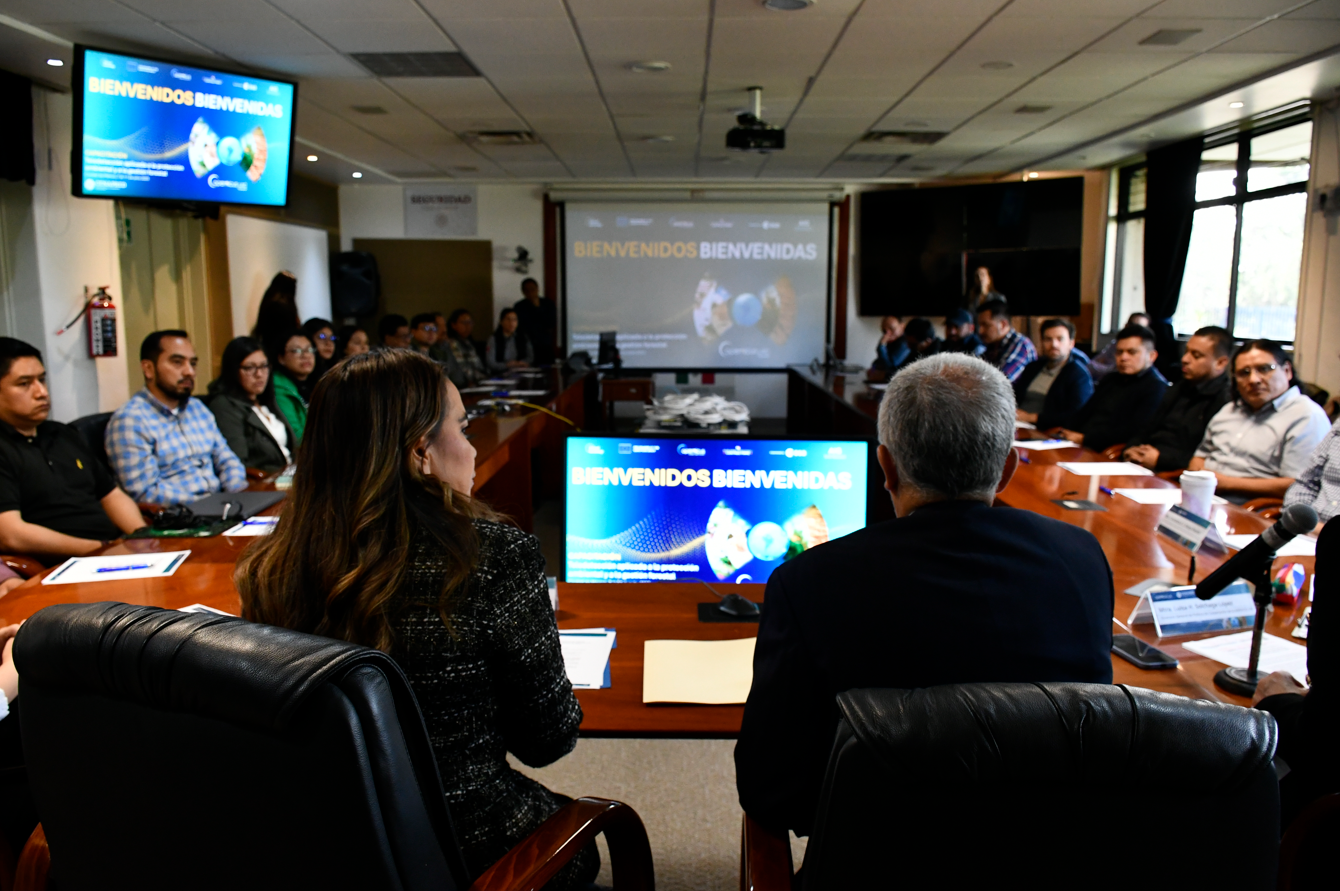 Opening ceremony of the training on Remote Sensing for Environmental Protection and Forest Management held at the facilities of the National Centre for Disaster Prevention (CENAPRED) in Mexico City, July 2025.
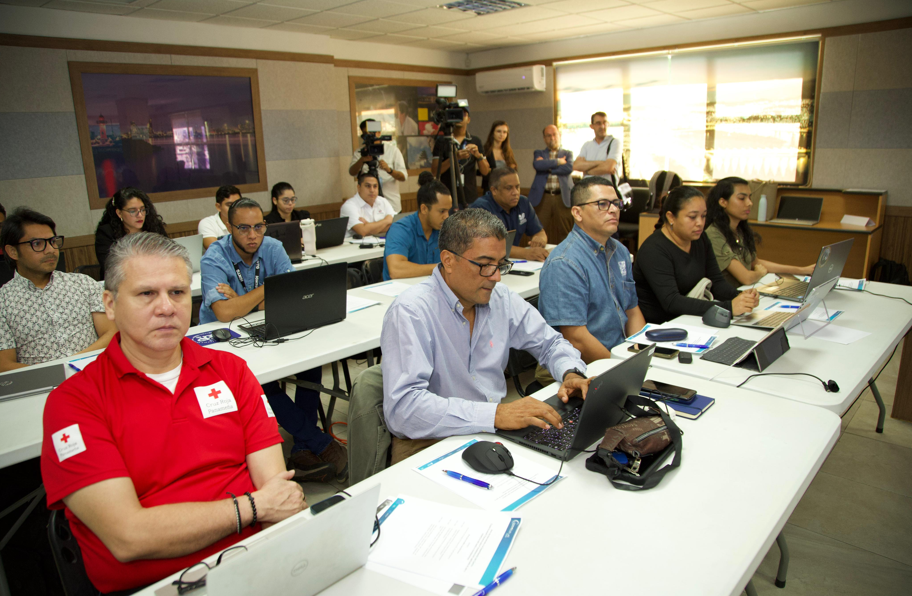 Participants in the course on Remote Sensing Applied to Land Use and Land Cover, held in collaboration with the National Government Innovation Authority (AIG) in Panama City, July 2025.
In addition, the Centre has expanded its reach through 3 online courses, which have enabled greater and more diverse participation from the entire LAC region. In fact, this format has been crucial in ensuring greater inclusion, guaranteeing that communities and professionals from all sectors could access specialised training without geographical barriers.
An additional significant feature of these courses is their emphasis on engaging young people, women, and members of indigenous communities. For example, a training session conducted in Ecuador addressed essential Earth Observation topics from an inclusive and diverse perspective.
Participation in international events and strategic dialogues
The Centre has also played a key role in international dialogues on climate resilience, disaster risk management (DRM), and Earth Observation data. Throughout the year, the CopernicusLAC Panama Centre Liaison Officers have actively participated in more than 20 strategic events within and outside the region, contributing their experience and knowledge.
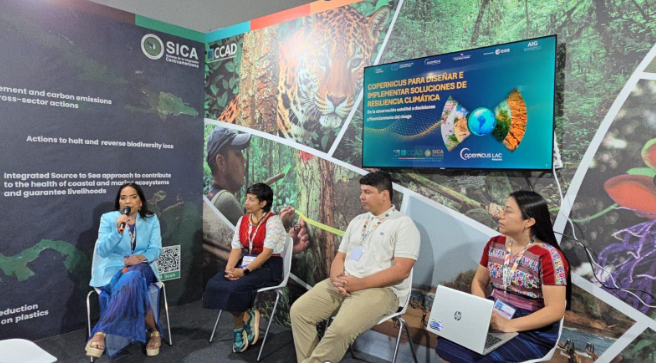 Claudia Herrera, Stakeholder Liaison Officer at CopernicusLAC Panama Centre, leading a panel at the side event held alongside the “Grandes Bosques de Mesoamérica” initiative during COP 30 in Belém, Brazil, in November 2025.
A highlight was the United Nations COP 30, held in Belém (Brazil) in November 2025, in which Claudia Herrera, Stakeholder Liaison Officer of the Centre, led a side event alongside the “Grandes Bosques de Mesoamérica” initiative, presenting how Copernicus and the Centre support LAC countries in turning satellite observations into concrete actions which strengthen the resilience of our most vulnerable forests and communities.
Another key moment of 2025 was the participation in June in a panel at the 68th session of the COPUOS (Committee on the Peaceful Uses of Outer Space) in Vienna. Moderated by Dr Benjamin Koetz of the European Space Agency, the discussion focused on the importance of collaboration between space agencies and local stakeholders to address global challenges such as climate change, disaster resilience, and sustainable development. During the same week, the recent progress made by the CopernicusLAC Panama Centre was also presented at the ESA’s flagship EO event: the Living Planet Symposium 2025.
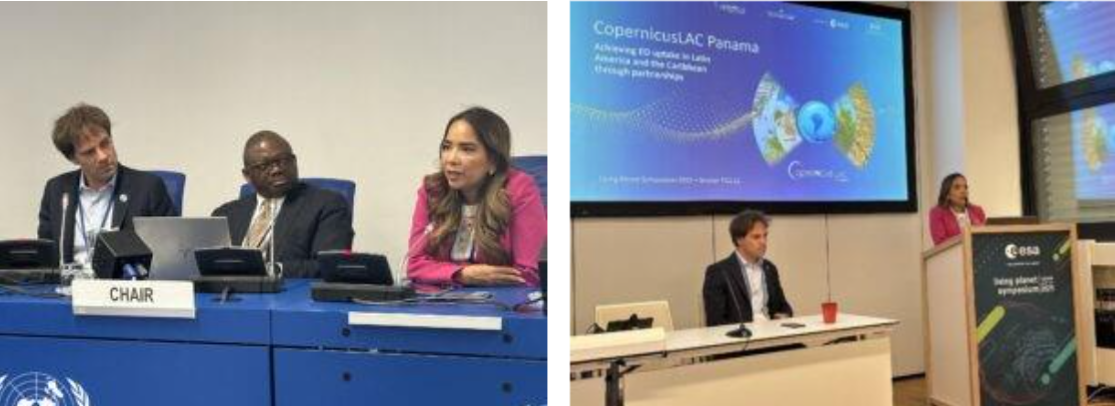 Claudia Herrera, Stakeholder Liaison Officer at the CopernicusLAC Panama Centre, participating in the COPUOS panel (left) and presenting the Centre at the 2025 Living Planet Symposium (right). Vienna, Austria, June 2025.
Another important milestone was the High-Level Policy Dialogue on Earth Observation in Antigua Guatemala, a key forum for discussing the future of Earth Observation in the LAC region, in which the Centre played a fundamental role in organising the event, where the debates reflected a deep understanding of the regional context. It was highlighted that Latin America and the Caribbean is one of the most exposed to systemic risk chains regions in the world, in which hydrometeorological, geophysical, environmental and socio-economic threats are intertwined. In this environment, Earth observation and open data ecosystems such as Copernicus were presented as key tools for real-time monitoring, mapping threats and exposures, and assessing their impacts, enabling more accurate and informed decision-making.
Another significant milestone was the High-Level Policy Dialogue on Earth Observation held in Antigua Guatemala, which served as an important forum for discussing the future of Earth Observation in the LAC region.
The Centre played a pivotal role in organising this event, with discussions demonstrating a nuanced understanding of the regional context. Participants emphasised that Latin America and the Caribbean are among the regions most exposed to systemic risk chains globally, facing hydrometeorological, geophysical, environmental, and socio-economic threats which are often interconnected. Within this context, EO open data ecosystems such as the ones provided by Copernicus were identified as essential tools for near real-time monitoring, hazards mapping, exposure assessment, and impact analysis, thereby supporting more accurate and informed decision-making processes.
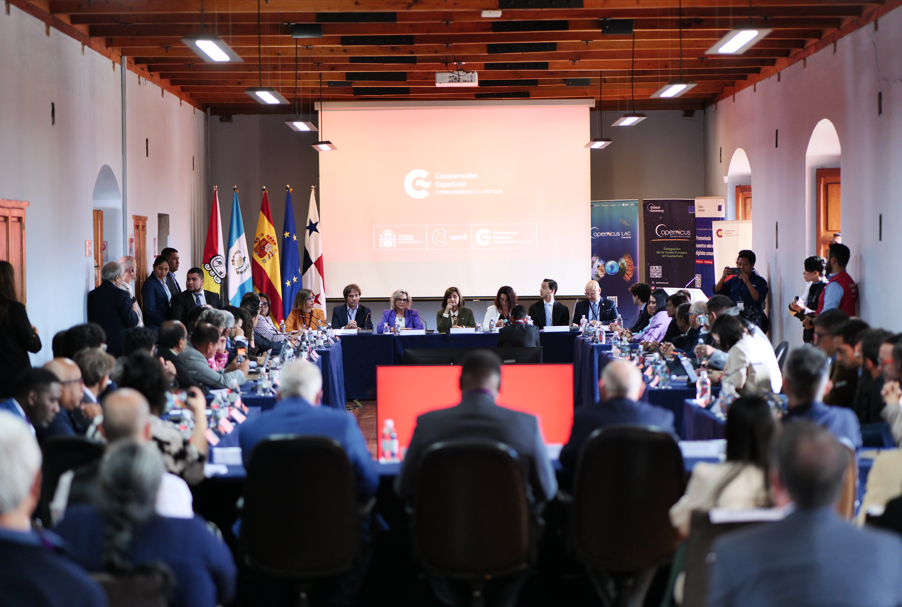 Opening ceremony of the High-Level Dialogue on Earth Observation, alongside the Vice-President of Guatemala, H.E. Karin Herrera, Dr Benjamin Koetz (ESA), Ms Silvia Viceconte (DG INTPA), Mr Rogelio García Boyd (Ministry of Foreign Affairs of Panama) and Mr Francisco García (AIG). Antigua Guatemala, September 2025.
Boosting innovation and cross-regional partnerships: 2025 Hackathon and Matchmaking
Collaboration with the private sector has also been a key area of activity for the CopernicusLAC Panama Centre in 2025. Through initiatives such as this year’s Matchmaking, connections between companies, start-ups and key players in the Earth Observation ecosystem has been fostered. These events have promoted the formation of strategic alliances between the European and LAC entities involved strengthening the Earth Observation ecosystem in the region.
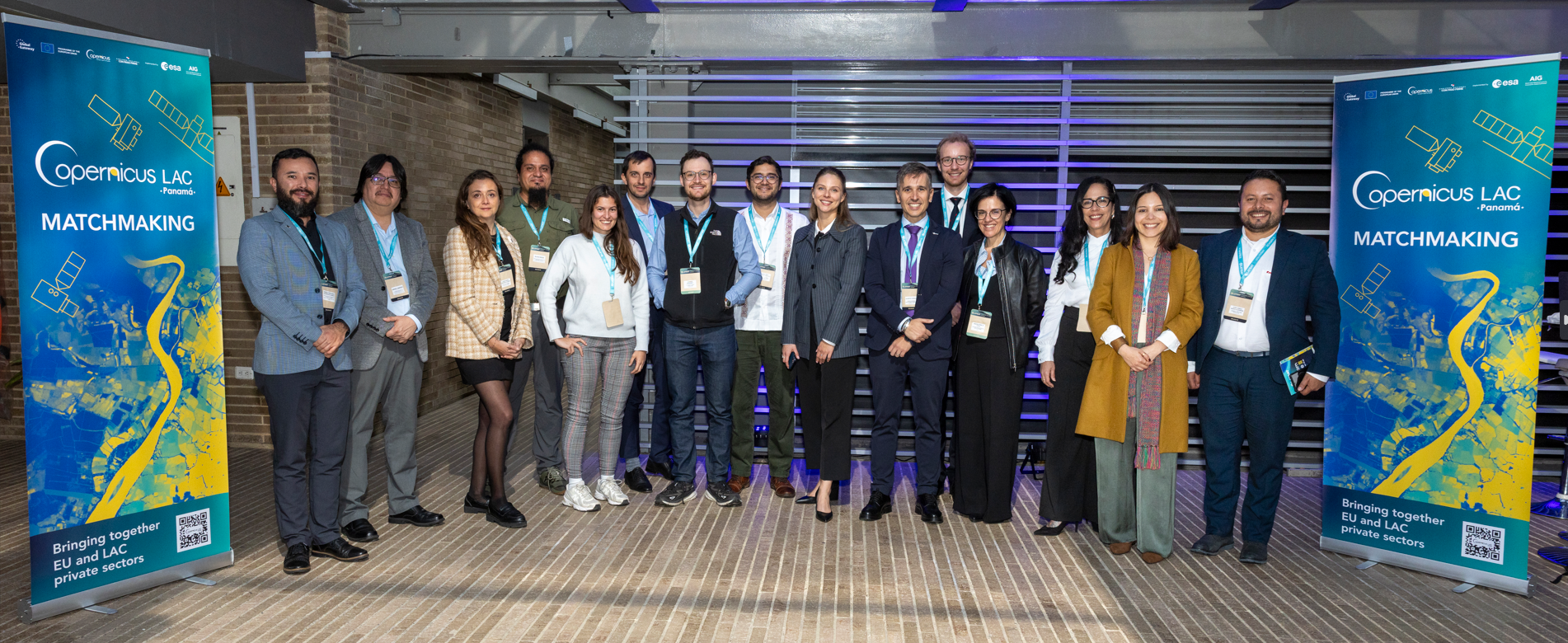 Participants from European, Latin American and Caribbean companies taking part in the Matchmaking 2025, as part of the LATSAT conference held in Bogotá, Colombia, in November 2025.
The CopernicusLAC 2025 Hackathon brought together young entrepreneurs and professionals from the technology sector to develop innovative solutions to environmental challenges. During the event, participants collaborated in multidisciplinary teams, leveraging Copernicus satellite data and digital tools to design practical applications with real-world impact.
Looking ahead
As a year marked by significant achievements and progress draws to a close, the CopernicusLAC Panama Centre is actively developing its plan for the activities to come. This forthcoming cycle will build upon the capacities developed during the last two years
In summary, 2025 has represented a pivotal year for the CopernicusLAC Panama Centre, both for its accomplishments and for the measurable impact achieved throughout the region. With a forward-looking approach and a strong conviction that regional cooperation is fundamental to addressing global challenges, the Centre reaffirms its commitment to increasing preparedness and resilience across the continent.
Background information
The activities of the CopernicusLAC Panama Centre fall within the overall context of the EU-LAC Digital Alliance, which is a strategic framework to promote cooperation between the European Union (EU) and the Latin America and Caribbean (LAC) region on digital and space issues under the umbrella of the EU Global Gateway strategy. In this context, the European Space Agency (ESA) coordinates the implementation of the Centre on the basis of a Contribution Agreement with the Directorate General for International Partnerships (DG INTPA) of the European Commission, and in close collaboration with the Government of Panama, the MIRE (Ministry of Foreign Affairs) and the SENACYT (National Secretariat for Science, Technology and Innovation).