




The CopernicusLAC Panama Centre took part in the cross-regional dialogue “From Space to Grassroots: Strengthening Community Resilience to Natural Hazards through Space Technologies”, held on 14 October 2026 at the European Commission’s Berlaymont building in Brussels.
The event brought together representatives of the European Union, regional organisations from Africa, Asia and Latin America and the Caribbean, United Nations agencies, national disaster risk management authorities, research centres, civil society organisations and the private sector It was organised by the Directorate-General for European Civil Protection and Humanitarian Aid Operations (DG ECHO) and the Directorate-General for Defence Industry and Space (DG DEFIS), in association with the Directorate-General for International Partnerships (DG INTPA) and the Joint Research Centre (JRC), and took place back-to-back with the third High-Level Dialogue of the EU-LAC Memorandum of Understanding on Disaster Risk Management (DRM).
A conversation on technology and community preparedness
The meeting sought to connect the capabilities of space-based systems, particularly the Copernicus Emergency Management Service (CEMS), with community preparedness and resilience. Two Main objectives guided the discussions:
- To demonstrate how Copernicus tools contribute to strengthening disaster risk management, through geospatial products such as flood extent maps, damage assessments and population exposure data.
- To explore how early warning systems can bridge technological capabilities and community needs, with a particular emphasis on humanitarian preparedness and community empowerment.
The programme included panels on EU space assets, digital twins for DRM, regional case studies from Latin America and the Caribbean, Asia, Africa and Europe, and the translation of data into actionable alerts. It also addressed DRM financing and international and public-private partnerships in the space sector.
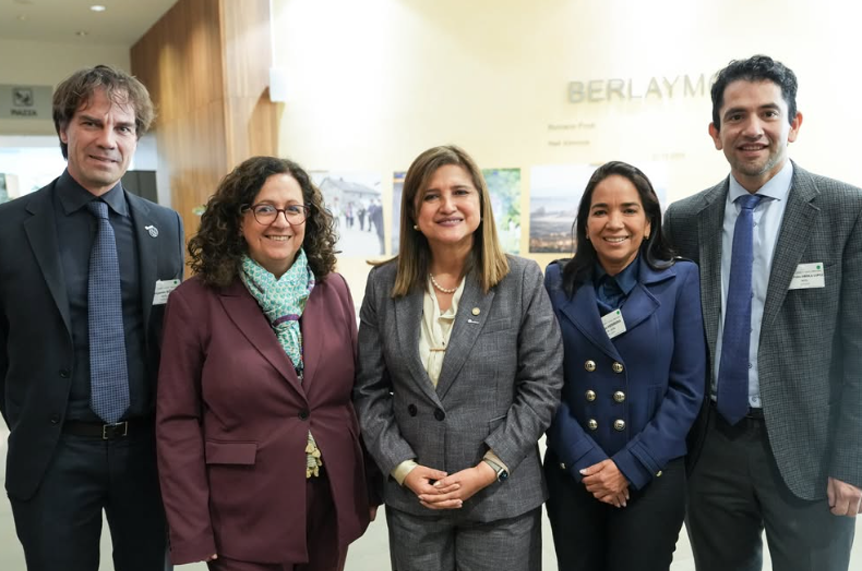
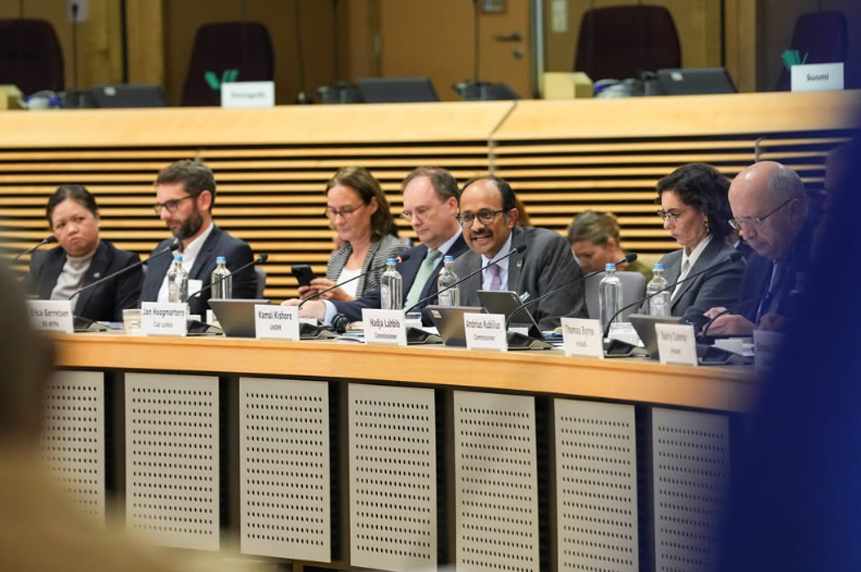
Contributions included an address by the Vice-President of Guatemala, Karin Herrera, who shared her country’s perspective on Earth Observation; interventions by Liz Riley of the Caribbean Disaster Emergency Management Agency (CDEMA) and David Farrell of the Caribbean Institute for Meteorology and Hydrology (CIMH) on the use of Copernicus services for hurricane monitoring in the Caribbean; and a contribution from Olga Lozano Cortijo of the Centre for Disaster Studies and Prevention (PREDES, Peru), who offered the perspective of a community-based organisation. The high-level panel featured European Commissioners Hadja Lahbib and Andrius Kubilius; Kamal Kishore, Head of the United Nations Office for Disaster Risk Reduction (UNDRR); and Thomas Byrne, Ireland’s Minister of State for European Affairs and Defence.
Towards closer cooperation with communities
Beyond satellite data, the dialogue highlighted that space technologies can help save lives when information reaches those who need it most in a timely, accessible, and actionable format. In this context, the CopernicusLAC Panama Centre will continue to support institutions across the region in the use of Copernicus data and services for disaster prevention, preparedness and response.
Background information
The activities of the CopernicusLAC Panama Regional Centre are part of the EU-LAC Digital Alliance, which is a strategic framework to promote cooperation between the European Union (EU) and the Latin America and Caribbean (LAC) region on digital and space issues under the umbrella of the EU Global Gateway strategy. In this context, the European Space Agency coordinates the implementation of the Centre on the basis of a Contribution Agreement with the Directorate General for International Partnerships (DG INTPA) of the European Commission, and in close collaboration with the Government of Panama, the Ministry of Foreign Affairs (MIRE), the Government Innovation Agency (AIG), and the SENACYT (National Secretariat for Science, Technology and Innovation).